For families
Alzheimer’s disease: what TPS can offer
A non-invasive treatment, six sessions over two weeks, at one of currently only two centres in the UK. You will know fairly quickly whether it has helped.
Where to start
Most people who contact us are asking about a parent or a partner
A wife whose husband has been slipping for two years. A son who noticed his mother repeating herself on the phone. A granddaughter who has read something and wants to know whether it is real.
If that is roughly where you are, you have likely already been told that the options are limited and that the direction of travel is one way. That is broadly true, and we are not going to pretend otherwise on a web page.
What we can tell you is that TPS is a real treatment, approved for Alzheimer’s disease, non-invasive, and short enough that you find out within a fortnight whether it is doing anything. For families who have been told there is nothing more to try, that is worth an hour of somebody’s time to explore.
Before treatment
What you will need first, and what it costs
A confirmed diagnosis
We cannot treat without one. If your relative has already been diagnosed, we work from that. If not, it needs to be made by an old age psychiatrist or a neurologist first.
A current brain MRI
The scan is loaded into the treatment system so it targets their brain specifically. For anyone continuing with maintenance we ask for an updated scan each year.
When TPS is not safe
A brain tumour or similar structural problem, a raised bleeding risk, or treatment with blood thinning medication. We check all of this before starting.
Neither the diagnosis nor the scan is arranged by us, and neither is included in our fee. Between them, budget around £1,000. We would rather set that out now than have you find it three weeks in.
One patient’s result
What a good outcome looks like
One of Dr Nabavi’s patients came to the clinic with a confirmed diagnosis of Alzheimer’s disease. Before treatment he scored 20 out of 30 on the Mini Mental State Examination, a standard test of memory, attention and orientation. A score of 23 or below indicates significant cognitive impairment.
After his course of TPS, he scored 26. That put him back above the threshold for significant impairment.
We are showing you one patient because we would rather give you a measured result than a testimonial, and because you should be able to see what a good outcome looks like before deciding whether to ask.
It is one person. For some people the change is smaller, and shows up as less agitation or better mood rather than a better test score. For some there is no benefit at all. Nobody can tell in advance which group anyone will be in, and we will not pretend to.
Two weeks, not two years
The initial course is six sessions across two weeks, three a week, 30 to 40 minutes each. That is the whole commitment.
If it has helped, maintenance is one session roughly every six weeks and continues for as long as it is worth doing. If it has not helped, you have spent a fortnight finding out, and you have not put your relative through anything invasive to do it.
We test cognition before and after, so the comparison is measured rather than remembered. Families are not always the best judges of gradual change in someone they see every day, in either direction.
Evidence
Promising, and still early
In the largest randomised, placebo-controlled trial of TPS so far, 60 people with Alzheimer’s each received both real and placebo stimulation. Cognitive scores improved more after real treatment than after placebo, but across the whole group that difference did not reach statistical significance. It did in patients aged 70 and under. Depressive symptoms improved significantly, brain imaging showed increased activity in memory-related regions, and detailed scanning found no harmful changes.
Matt et al. (2025), JAMA Network Open 8(2): e2459170.
So the position is this. TPS is approved for Alzheimer’s disease, it has a good safety record, and there is measurable evidence of effect. It is not a cure, it is not proven to work for everyone, and the evidence is still being built. If anyone offers you certainty about a treatment for Alzheimer’s disease, be careful.
What TPS is
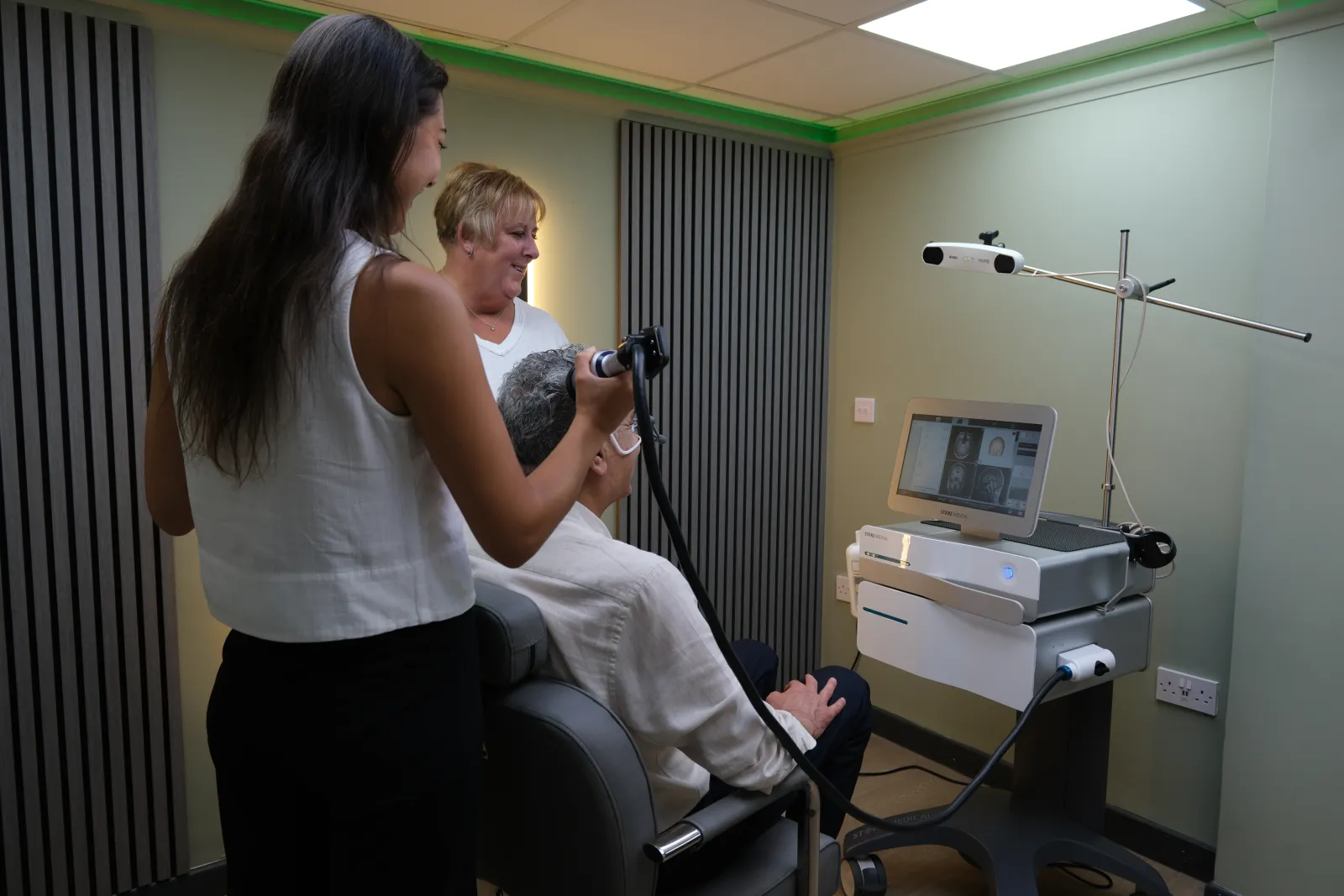
Very short ultrasound shockwave pulses, delivered through the skull, reaching around eight centimetres into the brain. Your relative sits in a chair, awake, for 30 to 40 minutes, with no anaesthetic and no sedation.
Alongside their usual treatment
TPS is given alongside standard Alzheimer’s medication, not instead of it. That is how it has been studied.
Targeted using their own scan
The MRI is loaded into the system so treatment is aimed at their brain rather than a generic model.
For care homes and nursing homes
We are happy to come and explain it
If you manage a care home or nursing home and have residents who might be suitable, we can visit and talk it through with your staff and with families.
Most people have never heard of TPS, including many clinicians, and it is easier to explain in person than in a leaflet. We are arranging information sessions for care and nursing homes, so get in touch if you would like one.
Common questions
Someone is with her throughout and the session stops if she wants it to. Most people find it unremarkable, and describe a light tapping on the scalp.
Cognitive testing before and after, and what you notice at home. Families often see a change in mood or engagement before anything shows up on a test.
No. TPS is given alongside standard Alzheimer’s treatment. That is how it has been studied.
Yes, and families do, because there are currently only two centres in the UK. Six visits over two weeks, then roughly one every six weeks if you continue.
We review it together and decide. There is no obligation to continue, and if we do not think it has helped we will tell you.
From £3,500 for the initial package, which covers the assessment with Dr Nabavi, the six sessions and one maintenance session. The diagnosis and MRI are separate, at around £1,000.
Talk it through with us
Most families call before anyone is sure of anything. Tell us what has been happening and we will explain what TPS involves and whether an assessment is worth booking.