
Where to start
Consultant psychiatric assessment
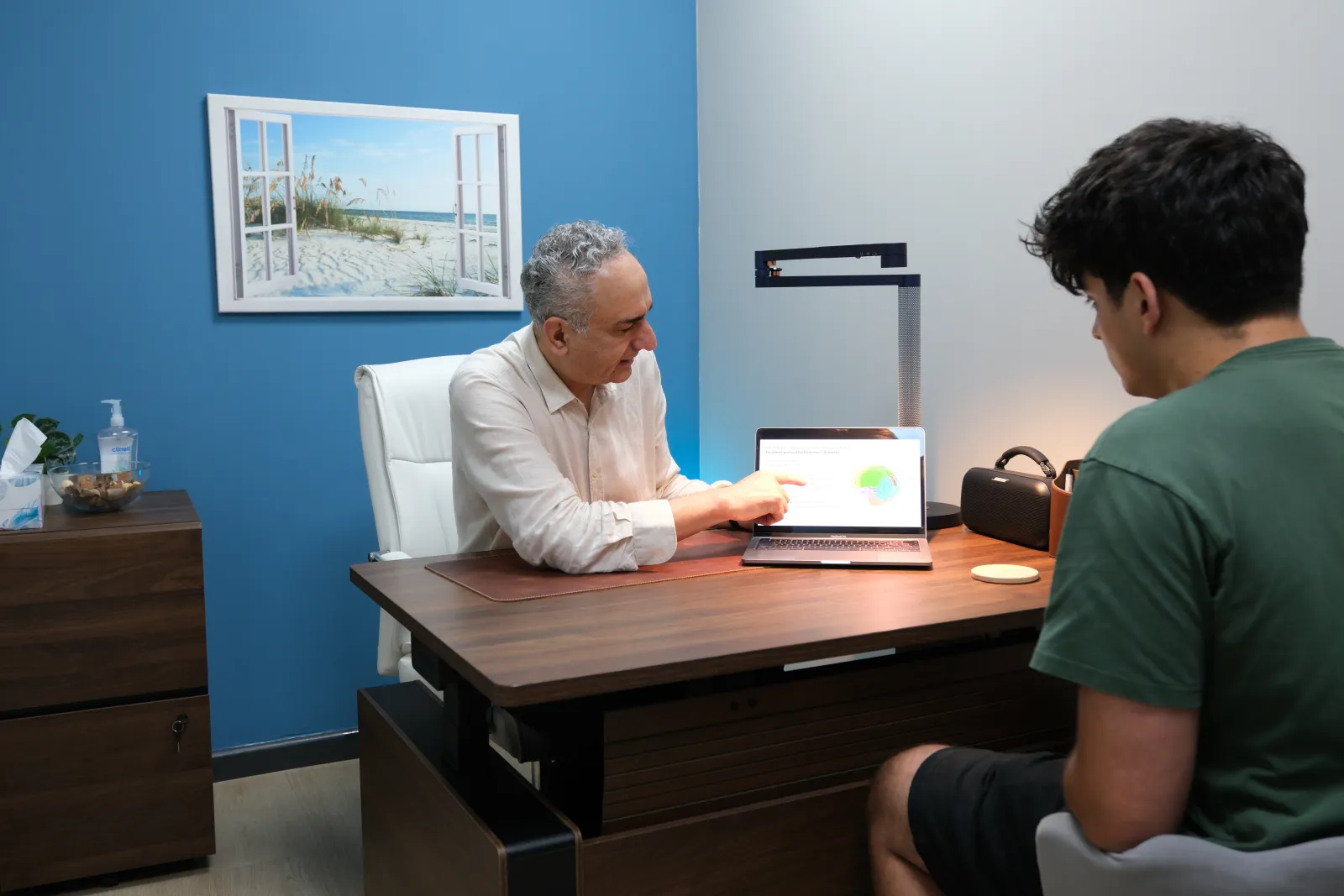
Most people who contact us are not sure which treatment applies to them. That is what an assessment is for. You spend an hour with a consultant psychiatrist who reviews your history and tells you honestly what your options are.
Why this comes first
You are not committing to treatment by booking one
If you have been unwell for a long time, the idea of starting something new can feel like another large decision on top of several that have not worked out. An assessment is not that.
It is a conversation whose purpose is to work out what, if anything, we can usefully offer you.
Some people leave with a treatment plan. Some leave with a recommendation to try something else first. Some are told that what they need is not something we do, and are pointed towards who does. All three are reasonable outcomes, and you are not charged differently for any of them.
Scope
Four main reasons people come
Mood and anxiety
Depression that has not responded to medication or therapy, bipolar disorder, anxiety, adjustment disorders and seasonal affective disorder.
Sleep disorders
Dr Nabavi has a particular interest in this area, including chronic insomnia.
PTSD
Assessment and treatment planning for adults with post-traumatic stress disorder.
Suitability for neuromodulation
Whether Deep TMS or TPS is a sensible option for you, and if so, which protocol.
The process
From first contact to a plan
A short phone call, free of charge
We find out roughly what is going on and whether an assessment is likely to be worth your time. If it is not, we will say so on the phone rather than book you in.
Your assessment with Dr Nabavi
A full psychiatric history: what you have experienced, what you have tried, what helped and what did not, and what you want to be different.
A recommendation
What we think would help, what it would involve, what it would cost, and what the alternatives are.
A letter to whoever prescribes for you
With your permission we write to your GP or your psychiatrist, so that everyone treating you is working from the same information.
Afterwards
Something written down
You are not signed up to anything by attending. If you want to think about it, take the recommendation away and think about it.
You do not need a referral from your GP. Most people contact us directly. If you have been referred by a GP, psychiatrist, psychologist or therapist, you stay under their care while you are treated here. We are providing a specific treatment, not taking over your care.
A written recommendation
Something you can read again later, and show to someone else.
A treatment plan
If treatment here makes sense: the protocol, the number of sessions and the cost.
A letter to your prescriber
To your GP or psychiatrist, with your permission.
£400, and it comes off your treatment
An assessment with Dr Nabavi is £400. If you go on to have Deep TMS or TPS here, that £400 is credited against the cost of your treatment. In practice the assessment costs you nothing if you proceed.
We charge for it because it is an hour of a consultant’s time, and because it keeps the diary for people who are seriously considering treatment. The initial phone call before it is free.
What we might recommend
Something we do not provide
In which case we will tell you what it is and, where we can, who does it.
Who you will see
An hour with Dr Nabavi
Dr Behrouz Nabavi (GMC 5174196) is a Consultant General Adult Psychiatrist and the clinic’s Medical Director, with 34 years of clinical experience. He holds a CCT in General Adult Psychiatry, is a Fellow of the Royal College of Psychiatrists, and is an Honorary Senior Lecturer at Aston Medical School.
Allow an hour for the assessment itself. The free phone call beforehand is usually ten minutes. You are welcome to bring a partner or a family member, and people often do where memory or concentration is part of what is going on.
Common questions
Allow an hour for the assessment itself. The free phone call beforehand is usually ten minutes.
With your permission, yes, and we think it is a good idea. If you would prefer we did not, say so and we will talk about it.
Then we say so. It happens, and we would rather tell you in an assessment than start you on something that is not going to work. Where we can point you to someone more appropriate, we will.
Yes. People often bring a partner or a family member, particularly if memory or concentration is part of what is going on.
Yes. An assessment with Dr Nabavi can be carried out online as well as at the clinic. If Deep TMS or TPS follows, the treatment itself takes place at the clinic, and CBT for insomnia can be online too.
Find out where you stand
You leave with a written recommendation you can read again at home or show your GP, even when it points to something we do not offer.