The only Deep TMS provider in Birmingham
Deep TMS (dTMS) in Birmingham
Deep TMS (deep transcranial magnetic stimulation) is a non-invasive form of TMS therapy for depression, OCD and smoking addiction. It uses magnetic pulses to reach the brain networks involved in each condition. We charge the same per session as clinics offering standard TMS.
The treatment
Awake, in a chair, for about half an hour
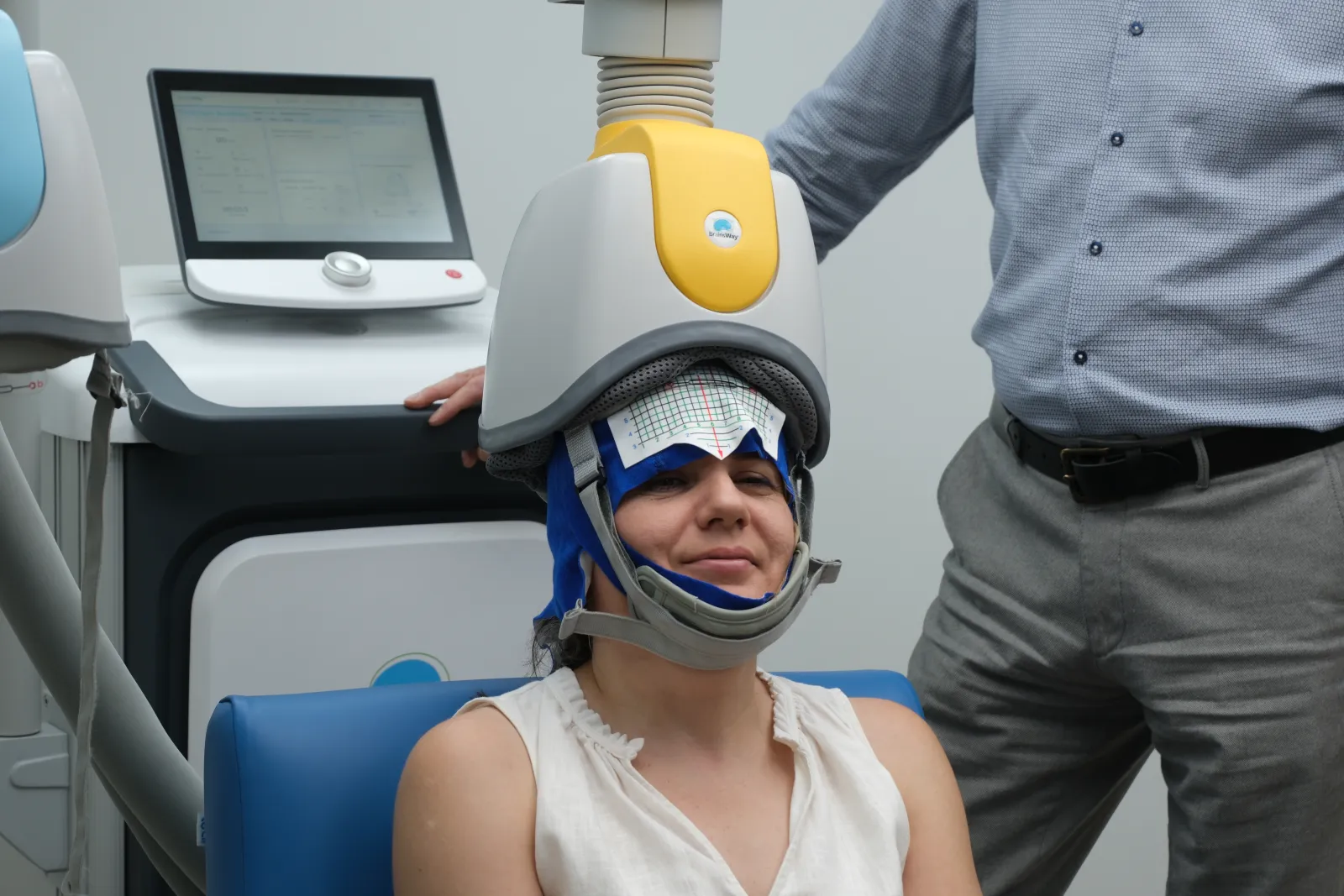
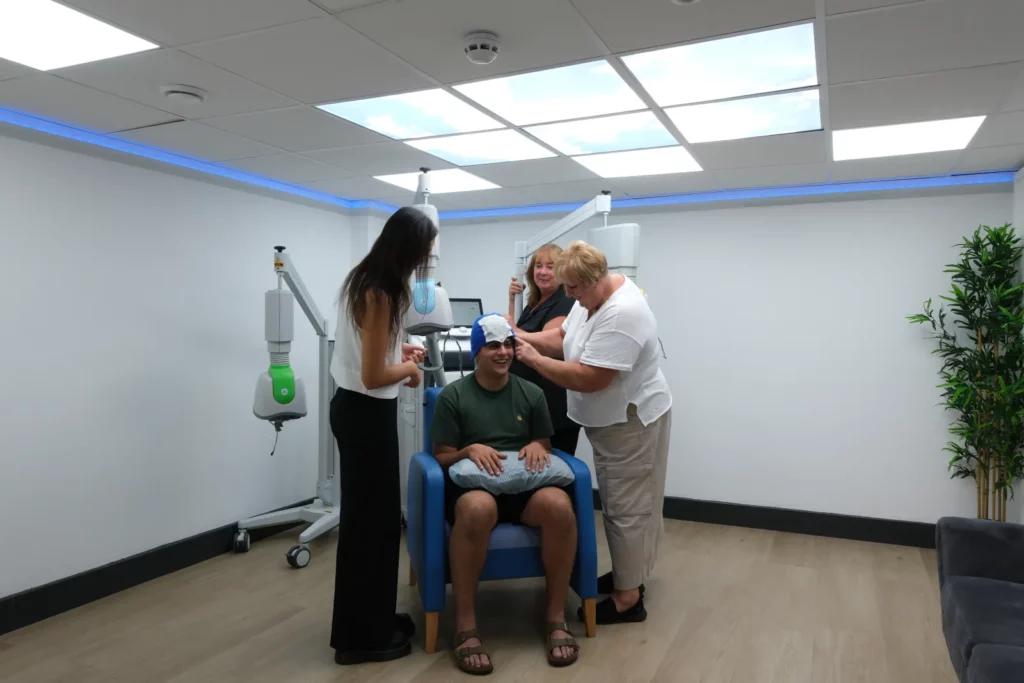
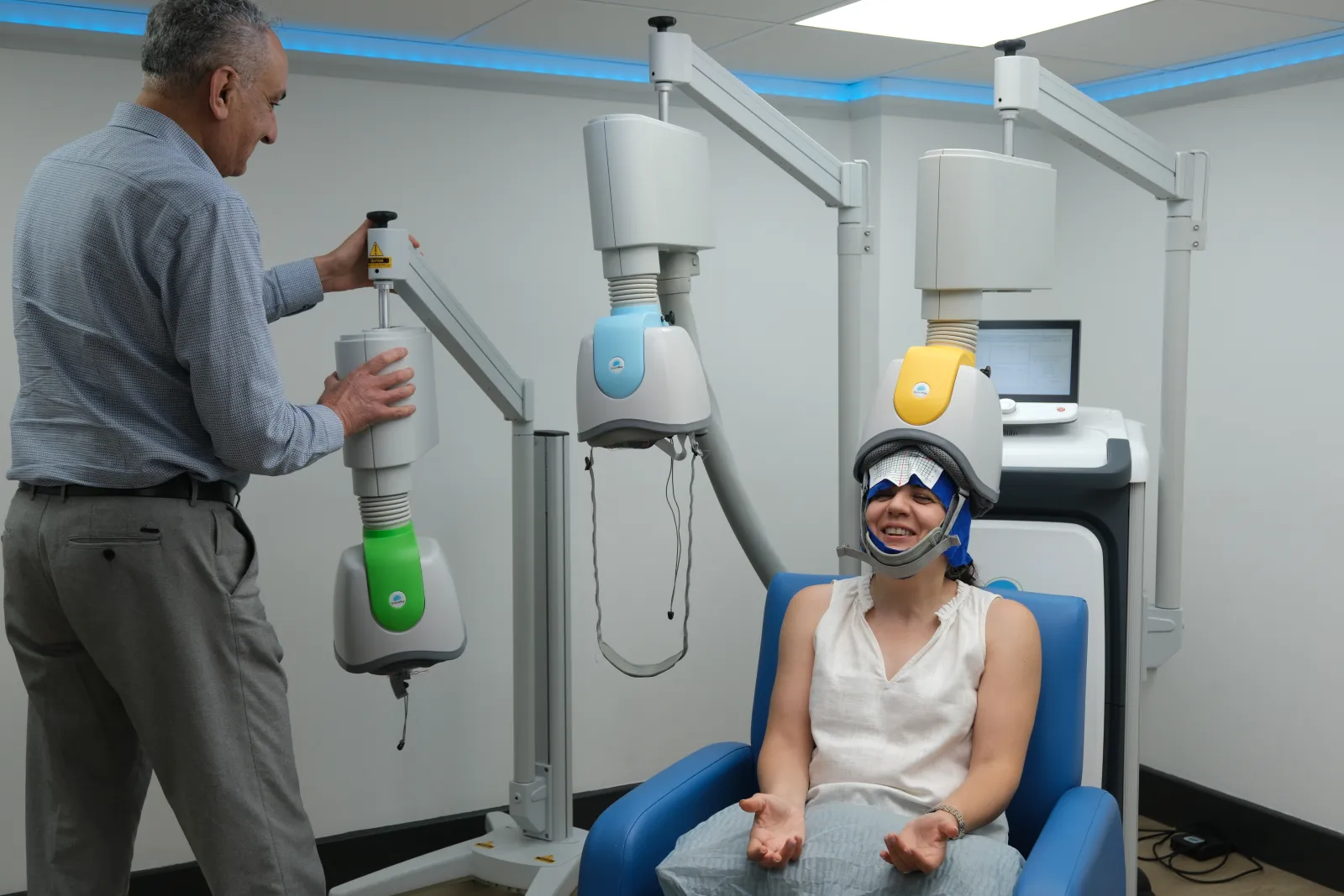
You sit in a chair wearing a padded helmet. The helmet delivers short magnetic pulses to a specific region of your brain. There is no anaesthetic, no sedation and no recovery time. A session takes 20 to 30 minutes, and you drive yourself home afterwards.
What the pulses do is harder to picture, so it is worth explaining properly.
Neurons pass messages to each other by releasing chemicals across the gaps between them, and that release depends on the electrical state of the cell. A magnetic field passing through the skull induces a small electrical current in the tissue underneath, which changes that state and prompts the neurons to fire. Stimulate a group of them repeatedly and they start working together more reliably.
Which group we stimulate depends on what we are treating: one region for depression and anxiety, a different one for OCD, another again for smoking addiction.
Deep TMS and standard rTMS
The coil is the difference
Most clinics in this region offer standard rTMS, the most common form of TMS therapy. Both treatments work on the same principle and both are FDA cleared. What separates them is the coil.
| Feature | Standard rTMS | Deep TMS at BNM |
|---|---|---|
| Coil | Figure-8 coil, held against the head | H-coil built into the helmet, fixed in place |
| Depth reached | About 2 cm | 3.5 to 4 cm |
| If you move during treatment | The coil can drift off target | The coil moves with you |
| Area stimulated | Narrower and more focal | Broader, so less chance of missing the region |
| Positioned by | The clinician, by hand, each session | The helmet, with weekly brain mapping |
| Price per session here | - | £250 |
If you have already had standard rTMS without enough improvement, that does not rule out Deep TMS. It is a different treatment, and it is worth a conversation.
What the research shows
One trial compared the two directly. 228 people with treatment-resistant depression were randomly assigned to 20 sessions of Deep TMS alongside their usual medication, 20 sessions of standard rTMS alongside their medication, or medication on its own.
66.7% of the Deep TMS group responded to treatment, against 44.0% of the standard rTMS group and 23.5% of those taking medication alone.
The difference between the two stimulation treatments was statistically significant. Remission rates also favoured Deep TMS, although that particular difference did not reach significance. Safety and tolerability were comparable between the two.
Filipčić et al. (2019), Journal of Psychiatric Research 114: 113-119.
Conditions we treat
Four FDA-cleared uses
Treatment-resistant depression
When two or more antidepressants have not worked well enough.
Anxious depression
Depression where anxiety is a prominent part of the picture.
Smoking addiction
For people who have tried to stop before and have not managed it.
What to expect
What a session is like
You sit down and the helmet is fitted
It is padded and adjustable. Nothing is attached to your skin.
The treatment runs in cycles
Roughly two seconds of pulses, then a pause, repeating across about 20 minutes.
You will feel a tapping on your scalp
Most people find it odd for the first session or two. Some find it uncomfortable. It usually stops registering after that.
You stay awake and can talk
A member of the clinical team stays with you throughout.
You leave and get on with your day
No recovery time, no sedation, and no restriction on driving.
How long it takes
Depression
5 sessions a week for 4 weeks, then 2 a week for a further 8 weeks.
36 sessions, around three months in total.
OCD
29 sessions, five a week, each preceded by a short symptom provocation.
Six weeks in total.
Smoking addiction
18 sessions: five a week for three weeks, then one a week for three weeks.
Six weeks in total.
Most people notice a change somewhere around the twentieth session. Some notice something in the first week, and a few take longer. In our experience the number of sessions you complete matters more than anything else, which is why the later, less frequent appointments are part of the protocol rather than an optional extra.
A full course in about two weeks
In the accelerated protocol each session lasts three to five minutes instead of 20 to 30, and you have up to five of them in a day. A depression course that normally runs for months is finished in a fortnight.
It suits people who cannot commit to daily appointments, and people travelling to us from outside Birmingham. Whether it is right for you is one of the things your assessment is for.
Precision
We remeasure every week, at no extra cost
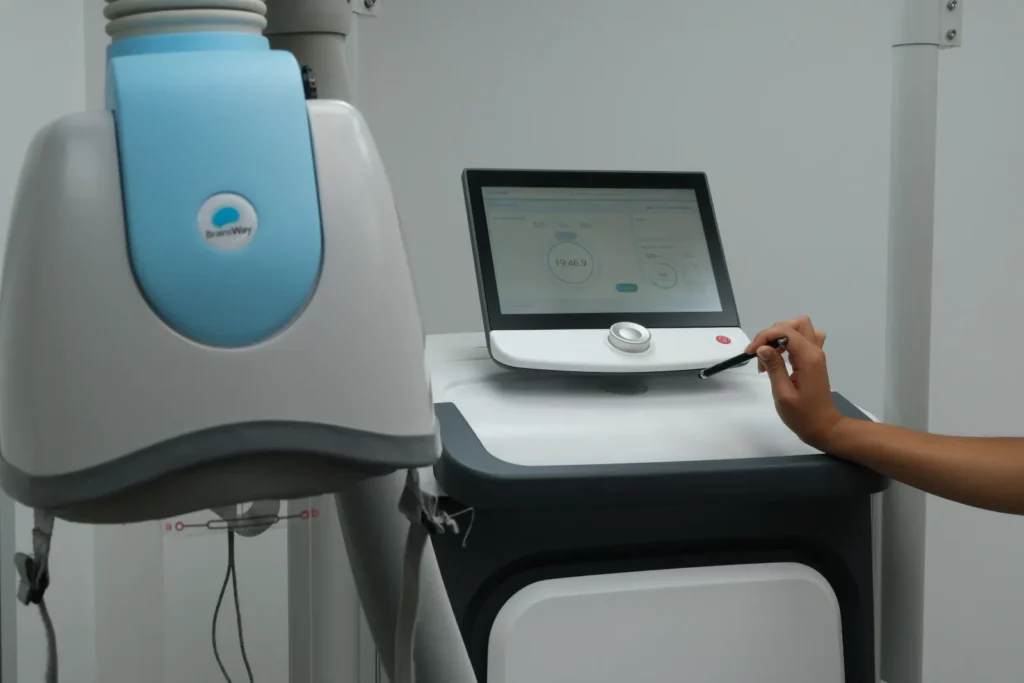
Before your first session, and once a week after that, we measure your motor threshold. This is the smallest amount of stimulation that produces a small involuntary movement in your hand or foot, and it tells us two things: how strong your treatment should be, and exactly where the coil needs to sit. It is usually called brain mapping.
It adds about 20 minutes to that day's appointment and there is no charge for it.
We repeat it weekly because the threshold shifts over a course of treatment. Treating at the setting we measured a month ago is not the same as treating at this week's.
Suitability
What we check before we treat you
Deep TMS is non-invasive and does not involve anaesthetic or surgery. It is not ECT, and it does not involve a general anaesthetic or a seizure as part of the treatment.
The main risk is an induced seizure. Published estimates put this at roughly one in ten thousand sessions, and it has not happened at this clinic. An induced seizure stops when the stimulation stops, and it does not mean you have epilepsy. Careful brain mapping is part of how that risk is kept low.
More common are a tapping discomfort during the session and a headache afterwards. Both usually settle within the first week of treatment.
You should not have Deep TMS if you have
Metal implants in your head or ears. Ordinary dental fillings are not a problem.
A history of seizures, or a condition that makes a seizure more likely.
Age range
The treatment is licensed for ages 16 to 82.
Alongside your existing treatment
You can continue medication and therapy throughout. Deep TMS was studied as an addition to standard treatment, not a replacement for it.
What this is approved for, and by whom
FDA cleared in the United States
The H1 coil for major depressive disorder and anxious depression, the H7 coil for OCD, and the H4 coil for smoking cessation.
NICE guidance
NICE says rTMS for depression may be used under normal clinical governance arrangements, having found no major safety concerns and adequate evidence of short-term benefit. It also notes that response varies from person to person, and that clinicians should tell patients about the other options available and about the possibility that the treatment will not help them. We follow that.
CQC registered
The clinic is registered with the Care Quality Commission.
Consultant-led
Every patient is assessed by Dr Behrouz Nabavi (GMC 5174196), Consultant General Adult Psychiatrist, Fellow of the Royal College of Psychiatrists and Medical Director of the clinic, before any treatment is offered. He has 34 years of clinical experience and is an Honorary Senior Lecturer at Aston Medical School.
Clear about the evidence
Protocols exist for PTSD and chronic pain, and research continues, but they are not approved indications and we do not advertise treatment for them. Dr Nabavi may consider it case by case after assessment, based on published evidence and expert opinion, and will explain exactly where the evidence stands.
Measured, not assumed
Your symptoms are scored on the same validated scales at set points, so whether it is working is a matter of record rather than impression.
What it costs
£250 a session
The same rate most clinics charge for standard rTMS, and the same whichever coil your treatment uses. A course is 36 sessions for depression, 29 for OCD and 18 for smoking addiction. We set out the full cost of your recommended course in writing before you start.
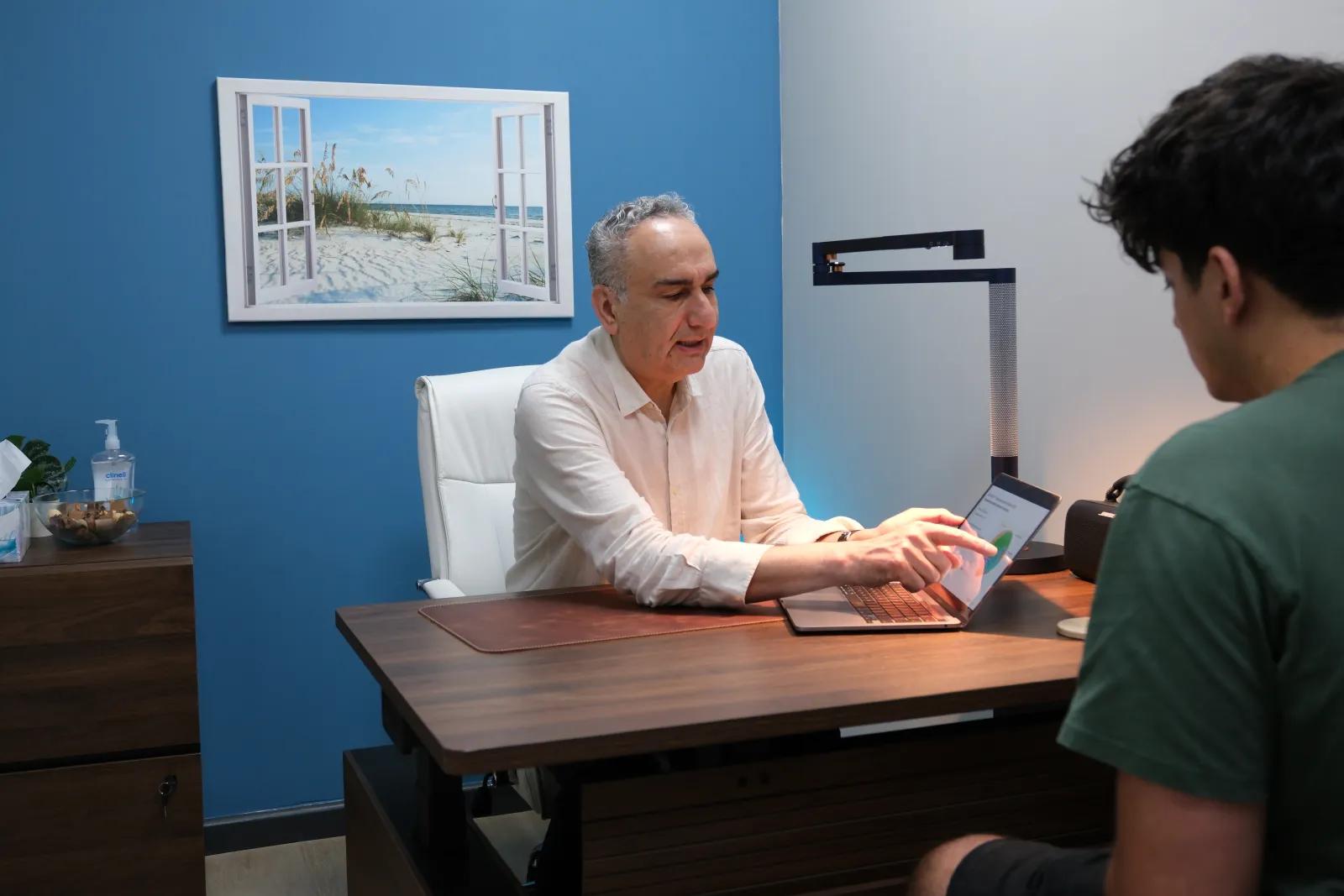
Before treatment you will need an assessment with Dr Nabavi, which is £400. If you go on to have Deep TMS, that £400 comes off the cost of your treatment.
Weekly brain mapping is included and the initial phone call is free. We set out the full cost of your recommended course in writing before you commit to anything.
Common questions
Yes. There is no sedation and no recovery period. People come in on their lunch break.
No. Deep TMS is given alongside medication, not instead of it, and the trial evidence is based on exactly that combination. Any change to your medication is a decision for you and whoever prescribes it.
Most people notice something around session 20, though some notice a change in the first week. We measure your symptoms with the same rating scales at set points, so the answer is not left to impression.
Some people do not respond, and we will tell you that honestly rather than keep you in treatment. Depending on your situation there may be other options, including a different protocol, pharmacogenetic testing to look at how you metabolise medication, or a referral back to your own psychiatrist with what we have learned.
No. ECT is given under general anaesthetic and deliberately induces a seizure. Deep TMS does neither. You stay awake, you go home afterwards, and there is no effect on memory of the kind associated with ECT.
No. You can contact us yourself. We will usually ask to keep your GP informed, and if you were referred by a psychiatrist or therapist you stay under their care while you are treated here.
Start with a free phone call
A ten-minute call is enough for us to tell you whether an assessment for Deep TMS makes sense, and what a course would cost you.