Currently one of only two centres in the UK
TPS therapy for Alzheimer’s disease
Transcranial pulse stimulation therapy is a non-invasive treatment that uses short ultrasound shockwave pulses to stimulate the brain. It has European regulatory approval for the treatment of Alzheimer’s disease, and we are currently the only centre offering it outside London.
The treatment
Short ultrasound pulses, about 8 cm into the brain
TPS uses very short ultrasound pulses rather than a magnetic field. They pass through the skull and reach around eight centimetres into the brain, which is deep enough to include structures that surface stimulation cannot influence.
Unlike Deep TMS, TPS is not aimed at one small region. We treat across the frontal, parietal and temporal areas, because the changes in Alzheimer’s disease are not confined to a single spot.
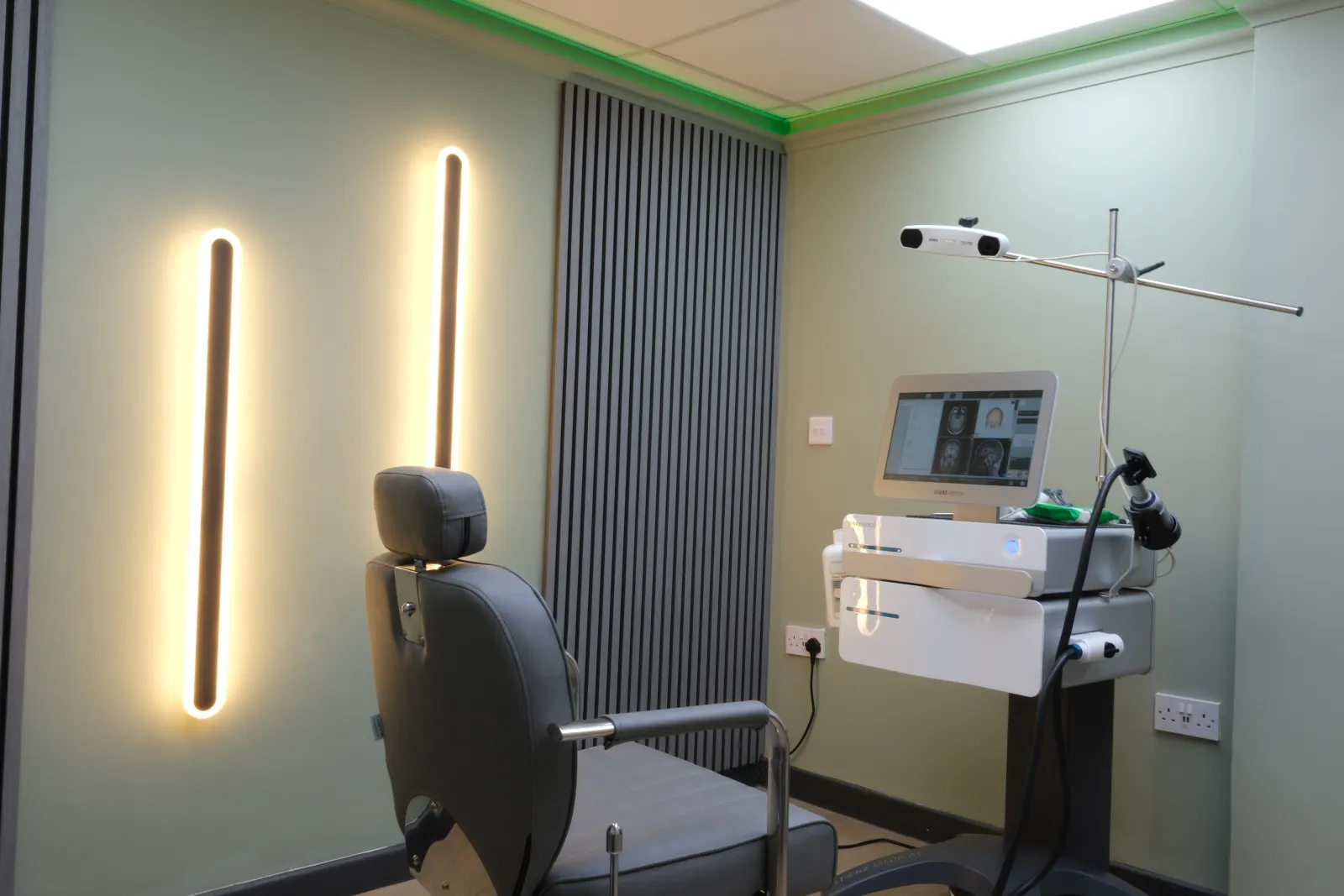
A session lasts 30 to 40 minutes. You are awake and seated throughout. There is no anaesthetic and no sedation, and you go home afterwards.
TPS and Deep TMS
Two different treatments, for two different problems
People often ask how TPS compares with Deep TMS. They are not alternatives to each other. Which one is appropriate depends entirely on the diagnosis.
| Feature | TPS | Deep TMS |
|---|---|---|
| What it uses | Ultrasound shockwave pulses | Magnetic pulses |
| Depth reached | Around 8 cm | 3.5 to 4 cm |
| Area treated | Broad: frontal, parietal and temporal | One targeted network |
| What we use it for | Alzheimer’s disease | Depression, OCD, smoking addiction |
| Course | 6 sessions over 2 weeks, then maintenance | 18 sessions for smoking, 29 for OCD, 36 for depression |
| Targeting | Guided by the patient’s own MRI scan | Guided by weekly brain mapping |
If you are not sure which applies, that is what the assessment is for.
Before treatment starts
What you will need before we can treat
A confirmed diagnosis
We can only offer TPS to people with a confirmed diagnosis of Alzheimer’s disease. If the diagnosis has already been made we work from it. If it has not, it needs to be made by an old age psychiatrist or a neurologist before we can treat.
A current brain MRI
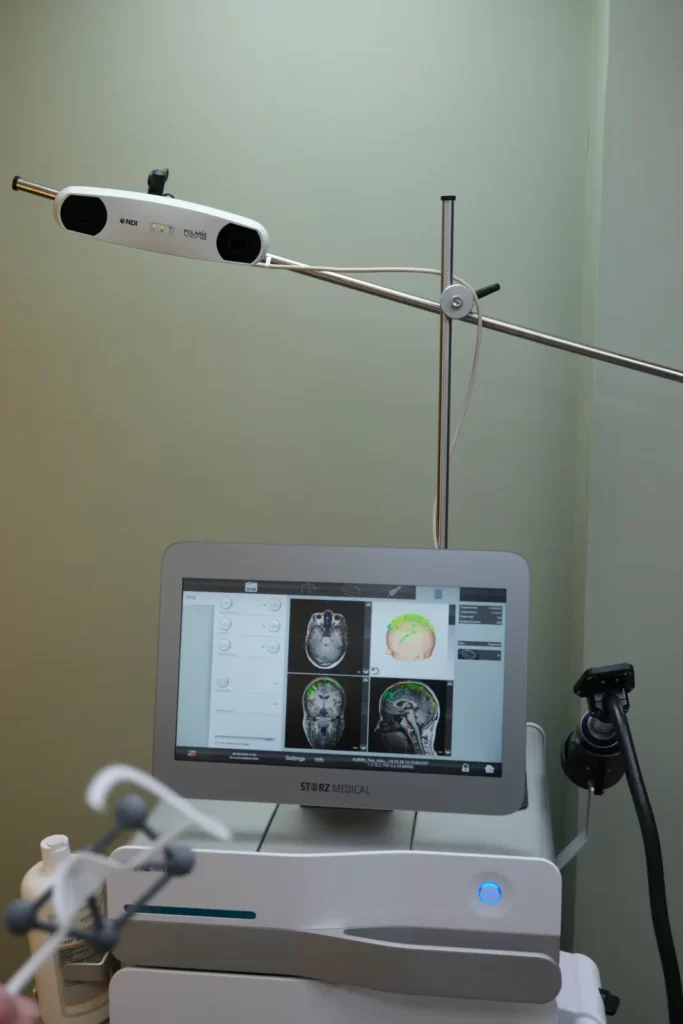
The scan is loaded into the treatment system so it targets your brain specifically rather than a generic model. We ask for an updated scan each year for anyone continuing with maintenance.
When TPS is not suitable
A brain tumour or other structural problem, a raised risk of bleeding, or treatment with blood thinning medication. We check all of this during assessment and screening.
Neither the diagnosis nor the scan is arranged by us, and neither is included in our fee. Between them, budget around £1,000. We would rather say that now than have you find out later.
What to expect
What a session is like
The scan is loaded first
Your MRI goes into the system so the treatment is aimed at your brain rather than an average one.
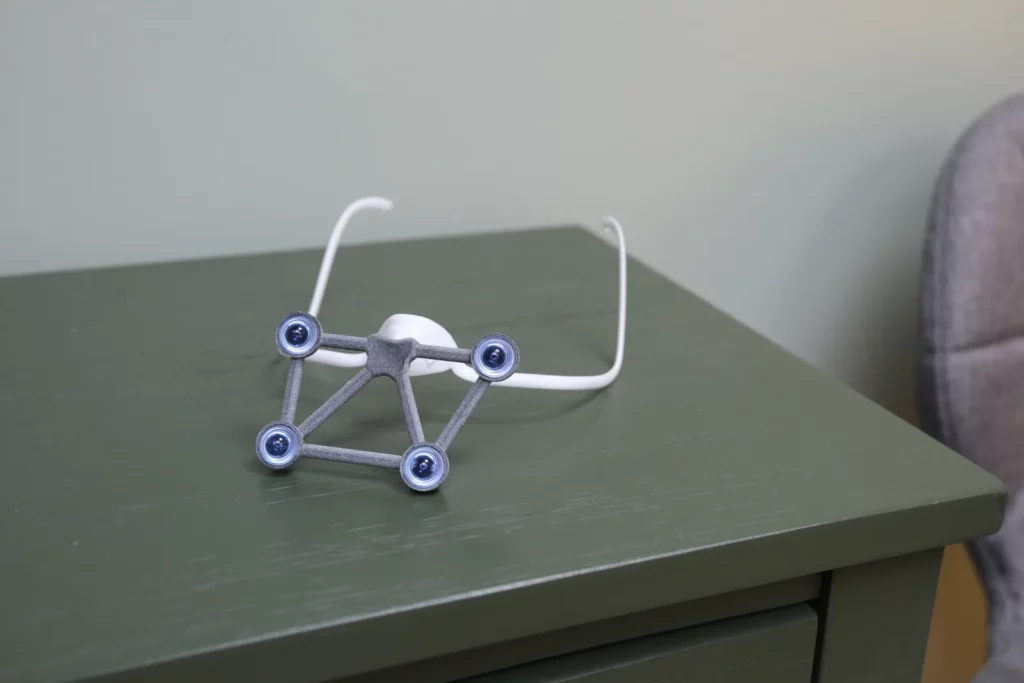
A light frame is fitted
It lets the system track the head, so the pulses stay on target if you move.
The pulses are delivered by hand
A clinician moves the handpiece across the scalp, guided by the scan on screen. Most people describe a light tapping.
You stay awake throughout
Seated, no anaesthetic, no sedation. Someone is with you for the whole session.
You go home afterwards
30 to 40 minutes, and no recovery time.
Results
It varies, and nobody can tell you in advance
Some people slow noticeably in their decline. Some see symptoms ease. Some show no benefit at all. We cannot predict which will happen, and no clinic can know in advance.
We measure rather than rely on impressions. Cognitive testing is done before treatment and again afterwards, so you and your family can see what has changed instead of wondering.
If you want to see what a good result looks like at this clinic, there is one on our Alzheimer’s disease page.
Measured, not remembered
Cognitive testing before and after, so you can compare the two sets of scores.
Alongside standard treatment
TPS is given alongside existing Alzheimer’s medication, not instead of it. That is how it was studied.
Well tolerated
Non-invasive, no anaesthetic, and detailed scanning in the trial found no harmful changes.
What the research shows
In the largest randomised, placebo-controlled trial of TPS so far, 60 people with Alzheimer’s each received both real and placebo stimulation. Cognitive scores improved more after real treatment than after placebo, but across the whole group that difference did not reach statistical significance. It did in patients aged 70 and under.
Depressive symptoms improved significantly, brain imaging showed increased activity in memory-related regions, and detailed scanning found no harmful changes.
So the position is this. TPS is approved for Alzheimer’s disease, it has a good safety record, and there is measurable evidence of effect. It is not a cure, it is not proven to work for everyone, and the evidence is still being built.
Matt et al. (2025), JAMA Network Open 8(2): e2459170.
Six sessions, and then you know
The initial course is three sessions a week for two weeks. That is the whole commitment. If it has helped, maintenance is a single session roughly every six weeks, continuing for as long as it is worth doing.
If it has not helped, you have spent a fortnight finding out, and you have not put anyone through anything invasive to do it.
Approved for Alzheimer’s disease
What we treat with TPS
Alzheimer’s disease, with a confirmed diagnosis. That is the approved indication, and the one we offer TPS for.
What is still research
TPS is being studied for Parkinson’s disease, mild cognitive impairment, ADHD and autism, and some of that research looks encouraging. None of it is an approved indication.
Where the evidence stands
These are not approved indications, and we do not advertise TPS for them. Dr Nabavi may consider it case by case after assessment, based on published evidence and expert opinion. If you have been reading about one of those studies, call and talk it through, and we will explain honestly where the research is.
Every patient is assessed by Dr Behrouz Nabavi, Consultant Psychiatrist and Medical Director, before any treatment is offered. The clinic is registered with the Care Quality Commission.
What it costs
From £3,500
The package covers your initial assessment with Dr Nabavi, the six treatment sessions, and one maintenance session.
Further maintenance sessions are charged individually.
The diagnosis and the MRI scan are not included, for the reasons above. Budget around £1,000 for those separately. We set out the full cost in writing before you commit to anything.
Common questions
No. TPS is given alongside standard Alzheimer’s treatment, not instead of it. That is how it was studied.
Cognitive testing before and after, plus what you notice at home. Families often spot changes in mood, engagement or agitation before anything shows on a test.
Yes, and people do, because there are currently only two centres in the UK. The initial course is six visits across two weeks, then roughly one visit every six weeks.
Yes. The assessment with Dr Nabavi can be carried out online as well as at the clinic, which helps if you are travelling a distance. The treatment sessions themselves take place at the clinic.
We review together. If it has helped, you move to maintenance. If it has not, we will tell you, and there is no obligation to continue.
Capacity is assessed as part of the process, and where someone cannot consent for themselves we work with the person holding legal authority to decide on their behalf. It is a normal part of what we do.
Start with an assessment
An hour with Dr Nabavi covers whether TPS suits your relative, what needs to be in place first (the diagnosis and a current MRI), and what the two weeks would look like.